


Will Russia go to war with NATO?
Are Russia’s current actions bringing us closer to a war with NATO? Before the invasion of Ukraine, the world was aware of a significant portion of Russia’s preparations, yet until just days before the invasion, there was still debate over the Kremlin’s intentions. We examine the current situation and whether a war between NATO and Russia is indeed inevitable.
In this analysis
- An empire divided
- Warheads for assurances
- Security on either side of the border
- The state moves closer to the president
- An election without an agreed result
- NATO in the future tense
- Yanukovych: the price of changing course
- Control first, voting afterwards
- A price Moscow could pay
- A war expected to end quickly
- The cost of waiting
- The exercise ends. The equipment stays.
- The talks continue. So do the preparations.
- Intelligence goes public
- Ukraine: between warning and alarm
- War did not require secrecy
- 2021 or 2022? A date is not a diagnosis
- Narva is not Crimea
- No casualties does not close the case
- Between warning and commitment
- We have heard this before. What does that tell us?
- A small territory, a large stake
- Who pays for the next front?
- The same questions, a different opponent
- When comparison is no longer enough
Are we moving towards a Russia–NATO war?
Russia’s policy towards Ukraine since the Soviet collapse, the preparations for the 2022 invasion, and what they tell us about the threat facing Europe today
Information as of September 23, 2026
Are we moving towards a direct war between Russia and NATO? Airspace violations, sabotage and warnings from European governments have brought that question out of the realm of distant scenarios. Yet counting incidents or comparing today’s rhetoric with statements made before the invasion of Ukraine will not answer it. Similarities are easy enough to find. What is harder to establish is whether the conditions under which leaders decide to use force are also similar.
Before 24 February 2022, the problem was not a complete absence of warning. Russian troops were moving towards Ukraine, Moscow was making demands about European security, and the United States was speaking increasingly openly about preparations for an attack. Nevertheless, almost until the invasion began, there was disagreement over whether Russian President Vladimir Putin intended to launch a major war or use his readiness to do so to extract concessions. Much of the preparation was visible. Its outcome was not.
What makes that comparison useful today is the relationship between Russia’s objectives, the means available to pursue them and the response it expects from its opponent. A ground invasion along several axes, a limited strike against a military facility and a sabotage operation require different forces. They leave different traces and give the defender different amounts of time to react. A similar number of alarming reports can therefore describe very different military situations.
A country covered by NATO’s collective defence also presents Russia with a different calculation from Ukraine outside the Alliance. There is no basis for treating war as inevitable. Nor can it be ruled out simply because NATO has greater combined resources or because we believe the costs would be too high for Moscow. In 2022, Russia launched an operation built on a mistaken assessment of its opponent. In a future crisis, a comparable mistake could concern the scale and speed of the allies’ response.
That Russian calculation had a much longer history than the final troop movements before the invasion. After the Soviet Union collapsed, Ukraine acquired its own borders and institutions but remained connected to Russia through industry, energy, military deployments and relationships between elites. Over the following decades, Moscow’s ability to use those connections to influence decisions in Kyiv changed. This history helps explain both the purpose of the war against Ukraine and Russia’s wider dispute with NATO: how far the security and policies of Russia’s neighbours should depend on the consent of its leadership.
An empire divided
In 1991, the Soviet Union faced simultaneous crises in its economy, its system of government and the relationship between the central authorities and the republics. Soviet leader Mikhail Gorbachev’s reforms had weakened the Communist Party’s monopoly without establishing an effective way to reconcile competing interests in an increasingly pluralistic state. Republican authorities were acquiring their own legitimacy and taking over powers previously exercised by the centre. Russia itself was part of this process. Boris Yeltsin, elected president of the Russian republic in June 1991, used its institutions to build his position against Gorbachev. This was not simply a conflict between Moscow and the periphery: two competing centres of power existed in Moscow itself.
The failed coup by conservative elements of the state apparatus in August 1991 accelerated the break-up. An attempt to preserve the USSR by force weakened the authority of its institutions and strengthened the conviction that the republics’ security depended on taking control of their own affairs. Ukraine’s parliament declared independence on 24 August. In the referendum on 1 December, 90.32 per cent of voters supported it, with majorities in every region, including Crimea and the Donetsk and Luhansk regions. Politically, the result mattered enormously: independence was neither exclusively a western Ukrainian project nor a decision taken by a small circle of activists.
On 8 December, the leaders of Russia, Ukraine and Belarus signed the Belavezha agreement, declaring that the USSR had ceased to exist and establishing the Commonwealth of Independent States. Other republics joined the CIS arrangements on 21 December. Gorbachev’s resignation on 25 December concluded a process in which the Soviet centre had lost effective authority over much of the country. Russia had helped bring about this outcome. Later accounts presenting the break-up solely as the work of hostile outside forces omit the role of Russia’s own leadership.
Bases, airfields, arms factories, pipelines and railways remained where they had been built. What changed was the state to which they belonged. Infrastructure designed over decades as a single system was divided by new borders, and a commander stationed in Ukraine could no longer assume that the existing chain of authority would go unchallenged. The allegiance of units, the subordination of personnel, ownership of weapons and rights to use facilities all had to be settled. Only then could independent systems of command, funding and training be built. Inheriting military equipment did not mean inheriting a ready-made capacity to defend a new state.
For Ukraine, state-building was particularly difficult to reconcile with keeping an economy dependent on Russian suppliers and customers functioning. A factory making part of a weapons system might remain in Ukraine while final assembly, orders and some components were located in Russia. Energy and industry needed raw materials; Russian gas exports, in turn, depended on Ukrainian transit infrastructure. This created interdependence in which both sides had instruments of pressure, but their overall economic and political resources were unequal. Kyiv had to reduce its dependence without immediately crippling important sectors of its economy.
One of the most difficult military questions concerned the Black Sea Fleet and its facilities in Crimea. Agreements reached in 1997 divided the fleet and allowed Russia to retain bases on Ukrainian territory under treaty arrangements. In 2010, then Ukrainian President Viktor Yanukovych agreed to extend the Russian fleet’s presence until 2042 in exchange for gas concessions. Energy dependence and security were directly connected: an immediate economic benefit entrenched a long-term Russian military presence.
None of this made a future war inevitable. It did mean, however, that Ukrainian sovereignty would also depend on whether Kyiv could stand by its decisions when Moscow responded with higher gas prices, trade restrictions or political pressure. Russia had many ways to exercise influence without sending troops across the border. As those instruments became less effective, a question grew more important: would Russia’s leaders accept a loss of influence, or try to recover it by force?
Warheads for assurances
Soviet nuclear warheads and their delivery systems remained on the territory of independent Ukraine. Judged by the number of weapons alone, Ukraine could appear to be one of the world’s largest nuclear powers. But its president had not inherited a complete, fully independent deterrent along with the country’s borders. That would have required control not just over the warheads but over their use, maintenance and replacement. Existing command procedures and technical infrastructure belonged to a Soviet system whose principal centre remained in Russia. Strategic weapons were also located in Belarus and Kazakhstan; their future was part of the wider division of Soviet military power.
Retaining an independent arsenal would have required more than a political decision. Technical, organisational and financial problems also had to be solved. Ukraine was in a deep economic crisis, while both Russia and the United States wanted to limit the number of nuclear states emerging from the USSR. Washington sought to preserve arms reduction and verification arrangements and prevent weapons systems and materials from becoming dispersed. Moscow had the additional interest of consolidating its status as the Soviet Union’s nuclear successor. American and Russian interests partly overlapped here, even as they diverged elsewhere.
The negotiations therefore concerned much more than where the warheads would go. Ukraine sought compensation for fissile material, assistance with disarmament costs and commitments concerning its security. On 14 January 1994, then US President Bill Clinton met Yeltsin and Ukrainian President Leonid Kravchuk in Moscow. Their Trilateral Statement linked the transfer of warheads to Russia with Russian supplies of fuel for Ukrainian nuclear power stations and American disarmament assistance.
The record of their conversation reveals how the decision was framed politically. Kravchuk affirmed the choice of disarmament; Yeltsin spoke of Russia and the United States providing for Ukraine’s security; Clinton presented the agreement as making all three countries safer. The participants could support the same document for different reasons. Kyiv wanted the best achievable terms for relinquishing the weapons; Washington wanted to reduce nuclear risks after the Soviet collapse; Moscow wanted the former Soviet strategic arsenal concentrated in Russia. A shared signing ceremony did not remove those differences.
On 5 December 1994, the Budapest Memorandum was signed by Clinton, Yeltsin, British Prime Minister John Major and Ukraine’s new president, Leonid Kuchma, who had replaced Kravchuk that summer. It accompanied Ukraine’s accession to the Nuclear Non-Proliferation Treaty as a non-nuclear-weapon state. The remaining strategic warheads had been transferred to Russia by 1996.
In the memorandum, Russia, the United States and the United Kingdom reaffirmed their respect for Ukraine’s independence, sovereignty and existing borders. Their commitments included refraining from the threat or use of force and from economic coercion intended to subordinate the exercise of sovereign rights. The document provided for consultations if questions arose about those commitments. It also contained provisions concerning nuclear weapons and recourse to the UN Security Council for assistance in specified circumstances involving aggression with such weapons.
It did not establish an obligation to conduct a joint conventional defence, or a standing military system capable of carrying one out. That distinction helps explain both Russia’s violation of its commitments in 2014 and the limits of the other signatories’ response. Russia broke principles it had itself affirmed. The United States and the United Kingdom, however, did not have the same alliance obligation towards Ukraine that they had towards NATO members. Their political responsibility towards a country that had relinquished its arsenal extended beyond the military mechanisms contained in the document.
The distinction becomes fundamental when comparing Ukraine’s position with Estonia’s today. Estonia’s government can ask not only what its partners have promised, but what allied troops, joint command arrangements, defence plans and reinforcement capabilities exist to support those promises. The Budapest Memorandum created no such system. Its fate is a reason to examine how a commitment would be fulfilled, rather than to assume that all forms of external protection are equally ineffective.
Security on either side of the border
For Poland, the end of dependence on the USSR did not automatically bring external protection. The Warsaw Pact was dissolved in 1991, and the last Russian troops left Poland in September 1993. Warsaw remained outside a system of collective defence while the future direction of Russian policy was uncertain. Seeking NATO membership was a way to tie Poland’s security to Western countries’ interests and military capabilities, and to consolidate its change of political orientation after 1989.
The outcome was not predetermined. Western allies considered the costs of new obligations, the capabilities of prospective members and the effect of enlargement on relations with Russia. The Partnership for Peace, launched in 1994, developed military cooperation but did not provide membership or Article 5 protection. Poland, the Czech Republic and Hungary were invited to accession talks in 1997 and joined in March 1999. The Baltic states joined in 2004. Their position was especially sensitive: small territories and limited defensive depth made rapid external support particularly important.
The same enlargement looked different from Warsaw and Moscow. For states joining NATO, limiting Russia’s freedom to exert pressure was one purpose of acquiring protection. For Russia’s leadership, it meant losing influence over neighbouring countries. Simply reassuring both sides that this was about security could not eliminate the contradiction. A more concrete question remained: could a state in the region choose an alliance even if Russia considered that choice contrary to its interests?
Russian opposition to enlargement also invoked the negotiations over German reunification. Declassified records from 1990 show that Gorbachev heard assurances about not moving NATO structures eastwards and about taking Soviet security into account. There is nevertheless a distinction between those statements, their political interpretation and a general treaty prohibition on the future accession of Central European states. The documents negotiated over Germany established no such prohibition. Those conversations belong to the history of mutual expectations and subsequent mistrust; they did not create an unlimited Russian veto over other countries’ policies.
The attempt to reconcile enlargement with cooperation with Moscow took the form of the 1997 NATO–Russia Founding Act. Among other principles, it affirmed states’ sovereignty and their right to choose how to provide for their security. NATO also stated that, in the security environment then prevailing and foreseen, it would rely on integration, interoperability and reinforcement rather than the additional permanent stationing of substantial combat forces. Neither party was given a veto over the other.
The practical consequence was important: formal defence commitments expanded faster than a permanent military presence in the east. The Alliance assumed that reinforcements could be delivered in a crisis. After Russia’s aggression in 2014, and more clearly after 2022, greater importance attached to forces already in place. Today’s debate about Baltic defence therefore also concerns the legacy of that design: how much can depend on future reinforcement if an aggressor tries to achieve a limited objective before it arrives?
The state moves closer to the president
Putin, then Russia’s prime minister, became acting president after Yeltsin resigned at the end of 1999 and won the presidential election in 2000. He did not immediately inherit a system in which every important decision depended on him alone. Regional leaders, business groups and competing parts of the central apparatus still had resources and influence of their own. Over the following years, their autonomy, media pluralism and the scope for meaningful political competition were curtailed. Studies by the Centre for Eastern Studies, or OSW, from the early years of his presidency and his second term show a gradual decline in the number of centres capable of challenging decisions from the top.
Control over economic resources developed in parallel. The renationalisation of some assets and the concentration of ownership around state enterprises increased the role of groups connected to the Kremlin. This was not a return to Soviet planning across the entire economy. Instead, large-scale ownership, managers’ positions and the ability to pursue strategic projects became increasingly dependent on relationships with the political centre.
This had two consequences for foreign policy. The Kremlin could more easily direct state resources towards costly objectives, even against the interests of some businesses and citizens. At the same time, it became harder to challenge the assumptions behind a decision effectively. This does not mean that Putin received only false reports. The question was whether information contradicting his assessment could not only reach him but also change policy.
This process helps explain why Ukraine’s experience mattered to the Kremlin beyond foreign policy. A change of government through elections and mass mobilisation in a culturally close country challenged the idea that societies in the region could function only under highly centralised rule. That does not prove that fear of democratisation was the sole or decisive motive for aggression. It does reveal another dimension of the conflict: an independent Ukraine could choose not only different partners but a different way of organising political power.
Nor is Russia’s system a single, seamless executor of every decision. Institutions and interest groups compete for money, positions and access to the leader. Highly personalised authority can make a politically risky operation easier to launch while making reliable information about its preparation and consequences harder to obtain. That matters when assessing a future confrontation: a centralised order guarantees neither effective coordination nor control over the opponent’s response.
An election without an agreed result
The presidential election of 2004 was to end Kuchma’s ten years in office. The principal rivals were serving Prime Minister Viktor Yanukovych, associated with the Party of Regions and the political and business establishment of the Donbas, and former Ukrainian Prime Minister Viktor Yushchenko, the opposition candidate. The contest concerned not only relations with Russia and the West but control of state institutions, the way power was exercised and whether elections could genuinely change who held it.
An event during the campaign altered both its political and its personal dimensions. In early September, Yushchenko became seriously ill and was admitted to a clinic in Vienna. His illness followed a dinner on 5 September with senior officials from Ukraine’s Security Service. When he returned to campaigning, increasingly severe changes to his skin were visible on his face. Yushchenko and his team spoke of poisoning, but the cause of his illness remained disputed for weeks.
On 11 December, doctors at the Vienna clinic announced that dioxin poisoning had been confirmed. Subsequent research by his medical team, published in The Lancet, documented severe TCDD poisoning and blood concentrations far above levels found in the general population. The poisoning itself is therefore not merely part of an election narrative. The medical finding does not, however, establish who administered the poison or who may have ordered its use.
Yushchenko blamed the incumbent political establishment. There were also suspicions concerning Russia, which supported Yanukovych. A 2005 US Congressional Research Service report recorded suggestions by Ukrainian officials that the poison had originated in Russia, while explicitly distinguishing those suggestions from an accusation that the Russian government had been complicit. Moscow’s evident political interest does not, by itself, bridge those gaps in what is known.
Public reactions were not uniform either. Media supportive of the authorities challenged the poisoning account, and the illness was used to question Yushchenko’s fitness for office. For his supporters, by contrast, his changed face became a visible sign of violence they associated with the system of power. The struggle for fair elections acquired an additional stake: whether people could challenge those in authority without risking their health or their lives. Confirmation of the diagnosis in December reinforced that interpretation before the rerun vote and made it harder for opponents to portray the illness as something discrediting the candidate.
The poisoning’s significance for mobilisation lay in this connection between personal experience and political interpretation. The candidate was not merely describing his opponents’ methods; to his supporters, his appearance gave allegations of violence a tangible, constant presence. It was an important part of the atmosphere in which later reports of electoral fraud were received. It cannot, however, be honestly converted into a number of additional votes, or its influence separated from opposition organisation, election monitoring, protests and the court’s decision.
After the second round on 21 November, the electoral commission declared Yanukovych the winner. Yushchenko and his supporters challenged the result, citing fraud. Their objections concerned real irregularities, not simply the losing side’s disappointment. OSCE observers described unequal campaign conditions, misuse of the state apparatus and problems with voting and the determination of results. Mass protests, known as the Orange Revolution after Yushchenko’s campaign colour, created pressure to reconsider the outcome. On 3 December, the Supreme Court ordered a rerun of the second round. Yushchenko won the vote on 26 December.
For Kuchma and Yanukovych, the result exposed limits to their control of the state. Their supporters had been unable to impose an outcome despite their administrative advantage. The protest remained a mass movement, judicial institutions helped resolve the crisis, and the compromise also included constitutional changes limiting the powers of the incoming presidency. This did not produce a system free of oligarchs, corruption or conflicts of interest. It did consolidate the ability of organised society and competing political centres to challenge the authorities.
From Putin’s perspective, the events showed that an agreement with part of Ukraine’s elite was insufficient to secure influence over the direction of the entire country. Explaining the protests solely as Western interference, however, ignored their domestic causes. Ukrainians had an interest of their own in making elections determine who governed. In an assessment written soon after the events, OSW stressed the importance of public expectations, resistance to centralisation and the defence of independent action.
The years that followed showed that the result of 2004 had not ended the contest. Conflict within the victorious camp, disappointment with its performance and the durability of regional political organisations allowed Yanukovych to return. He won the presidential election in 2010. His presidency was therefore not simply a continuation of the disputed result of 2004. It had an electoral mandate. Subsequent decisions, the concentration of power and repression brought about the next crisis.
This period matters when assessing Russian expectations before 2022. Ukraine had serious institutional weaknesses, but it also had experience of mass mobilisation and replacing its rulers. Corruption and conflict between oligarchic groups did not mean that society would accept a government imposed from outside. Confusing those things could produce a deeply mistaken assessment of the state’s resilience under attack.
NATO in the future tense
At NATO’s Bucharest summit in April 2008, Ukraine and Georgia received a public declaration that they would become members of the Alliance. They received neither an accession date nor, at that point, a Membership Action Plan. Their governments could invoke a promise about the future, but they remained outside collective defence against an immediate threat. Russia opposed the announced change before a military system existed to protect the prospective members. The gap between a political declaration and a current defence obligation mattered far more than a dispute over the timetable for enlargement.
Georgia had unresolved conflicts over Abkhazia and South Ossetia, where Russia supported separatist structures and participated in peacekeeping arrangements. Tensions and incidents increased during the summer of 2008. The EU-sponsored fact-finding mission concluded that Georgian shelling of Tskhinvali on the night of 7–8 August began the large-scale phase of the conflict, and did not find it legally justified. It also described the preceding escalation and a Russian campaign extending far beyond the defence of Russian peacekeepers. Responsibility for the conflict as a whole cannot therefore be explained by identifying a single first shot.
After the war, Russia recognised the independence of both separatist regions and entrenched its presence there. Georgia survived as a state, but its territorial control was diminished. For other countries in the region, this demonstrated that cooperation with the West without membership was not equivalent to allied defence. It did not mean that every country outside NATO would be attacked. It meant that the cost of Russian force also depended on specific external commitments and the willingness to honour them.
The war also became a reference point for rebuilding Russia’s army. Reforms led by then Defence Minister Anatoly Serdyukov changed military structures and the supporting establishment inherited from the USSR. The subsequent change of minister did not simply reverse that process. Russia’s capacity to conduct the operations of 2014 also grew out of those reforms. It did not enter the next conflict with an army left unchanged since the Soviet collapse.
After taking office in 2010, Yanukovych adopted a non-aligned policy and abandoned the pursuit of NATO membership. This did not end disputes with Russia over Ukraine’s independence of action. In 2013, pressure focused on an agreement with the European Union. That places an important limit on explanations reducing the entire conflict to the enlargement of a military alliance: Ukraine outside NATO was still making economic and political choices that Moscow was unwilling to accept.
Yanukovych: the price of changing course
In 2013, Ukraine was negotiating an Association Agreement with the European Union, including a Deep and Comprehensive Free Trade Area. It was neither an agreement to join NATO nor a commitment to rapid EU accession. Its importance lay in gradually aligning Ukraine’s economy and institutions with European rules. For businesses, that meant market access as well as the cost of adjustment; for the state, changes to law and public administration. Over time, it would reduce the scope for arranging economic policy solely through agreement with Moscow.
Russia offered Ukraine integration into its own customs union project and applied trade pressure. In August 2013, stricter Russian customs controls obstructed Ukrainian exports. The message was clear: choosing an agreement with the EU could impose immediate costs in the Russian market before the longer-term benefits of European integration emerged. Yanukovych had to consider both the public finances and the interests of businesses that formed part of his political base.
On 21 November, the government of Ukrainian Prime Minister Mykola Azarov suspended preparations to sign the agreement ahead of the Eastern Partnership summit in Vilnius. Supporters of European integration began protesting. Their initial grievance was specific: the authorities had abandoned a policy they had themselves presented as desirable. On the night of 29–30 November, Berkut riot police brutally dispersed demonstrators still on Kyiv’s Maidan. The violence changed the mobilisation. People opposing the economic decision were joined by those opposing the beating of protesters and the impunity of the state apparatus.
After the beatings, Yanukovych faced a different problem from the one he had faced a few days earlier. Initially, he might have tried to defuse the protest by returning to negotiations with the EU. After violence had been used, he would also have to account for the security forces’ conduct and offer credible assurances against further repression. Protesters’ demands had widened while the government’s promises had become less credible. Meanwhile, the infrastructure of a sustained protest was taking shape: accommodation, supplies, medical assistance and self-defence groups. Opposition politicians participated but did not fully control everyone involved. Negotiating with party leaders therefore did not guarantee an end to the protest.
At a meeting with Yanukovych in Moscow on 17 December, Putin offered a package including purchases of Ukrainian bonds worth up to $15 billion and a reduction in gas prices. It gave Yanukovych a way to relieve financial pressure without an EU agreement or the conditions attached to assistance from Western institutions. It was not, however, an unconditional transfer of the entire sum. Phased implementation left Moscow with influence over Kyiv’s subsequent position. Economic assistance thus reinforced the president’s political dependence just as his domestic position was weakening.
On 16 January 2014, parliament adopted a package of restrictions on protest and civic activity through a disputed voting procedure. Some participants saw this as closing off peaceful means of pressure. Serious clashes began near Hrushevsky Street on 19 January, and protesters’ deaths from gunshot wounds were recorded on 22 January. Towards the end of the month, Azarov resigned and most of the restrictive measures were repealed. Those concessions did not restore the trust needed to end the crisis.
Violence in Kyiv reached its greatest intensity on 18–20 February. Many demonstrators and police officers died; numerous protesters were killed by gunfire. Responsibility for individual killings became the subject of years of legal proceedings with differing courses and outcomes. The political result, however, was a rapid collapse in Yanukovych’s ability to retain power. Parts of his support base deserted him, and a compromise leaving him in office became increasingly difficult for protesters to accept.
On 21 February, Yanukovych signed an agreement with three parliamentary opposition leaders: Arseniy Yatsenyuk of Batkivshchyna, Vitali Klitschko of UDAR and Oleh Tyahnybok of Svoboda. It provided for a return to the 2004 constitution, a government of national unity and an early presidential election by December at the latest. Polish Foreign Minister Radosław Sikorski and German Foreign Minister Frank-Walter Steinmeier took part in mediation alongside French representatives. Sikorski and Steinmeier signed as witnesses.
The proposed compromise allowed Yanukovych to remain in office for a time while reducing his powers and opening the way to an early election. Opposition leaders assumed responsibility for persuading protesters that this remained an acceptable solution after the killings on the Maidan. They failed to secure that acceptance. The distinction matters: an agreement signed by party leaders was not the same as consent from people who had organised and borne the costs of the protest for months.
Yanukovych left Kyiv. On 22 February, parliament declared that he had ceased to perform his duties and scheduled an election for 25 May. The full constitutional impeachment procedure was not completed. At the same time, the previously elected parliament remained in operation, and some decisions were supported by deputies from the former governing camp. Events therefore departed from the settlement agreed just one day earlier. Instead of a gradual transfer of powers and preparations for an election, central government changed abruptly.
Parliament was functioning in Kyiv, the president had left the capital, and the agreed route out of the crisis was no longer being followed. This gave Russia an opportunity to exploit the weakness of Ukrainian institutions. It gave Russia no right to decide who should govern a neighbouring state or to seize its territory. The distinction between an opportunity to act and an entitlement to do so is essential: the crisis helps explain the timing of the operation, but does not justify aggression.
Control first, voting afterwards
In Crimea, Russia enjoyed conditions it did not possess in every Ukrainian region: an existing military presence, infrastructure, knowledge of local institutions and political connections. With the authorities in Kyiv disorganised, these advantages allowed it to seize the initiative quickly. On 27 February, armed soldiers without insignia occupied the buildings of Crimea’s parliament and government. Ukrainian units were then blockaded and key facilities taken over. Arguments about the legality of local decisions were already taking place under conditions of overwhelming Russian military superiority.
The referendum of 16 March did not precede that shift in power; it followed it. It offered no free choice to retain the existing status and was held in violation of Ukraine’s constitutional procedures. On 18 March, Russia signed documents incorporating Crimea. UN General Assembly Resolution 68/262 affirmed Ukraine’s territorial integrity and stated that the vote could not provide a basis for changing the peninsula’s status.
Militarily, annexation gave Russia control of bases and freedom to expand its Black Sea capabilities without negotiating terms with Kyiv. Politically, Putin could present territorial acquisition as his answer to the loss of a friendly government in Ukraine. It did not solve the problem of influencing the rest of the country. On the contrary, the use of force increased Ukrainian mistrust of Russia and weakened those advocating a close relationship with Moscow.
The Donbas followed a different course. In the spring, pro-Russian groups occupied administrative buildings while armed formations took control of successive towns. Genuine local conflicts and fears about the changes in Kyiv existed, but they do not, on their own, explain how the war developed. External weapons supplies, Russian personnel and organisational support enabled operations on a scale that cannot be accounted for as spontaneous local protest. The European Court of Human Rights’ findings concerning Russia’s effective control over separatist-held territory are an important counterweight to the account of Russia as merely a mediator.
On 11 May, separatist authorities held votes intended to legitimise the emergence of “republics” in Donetsk and Luhansk. These were not comparable to ordinary elections conducted under independent administration, with verifiable voter registers and freedom to campaign. Their function was to give political form to structures developing through violence. Subsequently presenting the conflict as a dispute between Kyiv and equivalent political entities helped Russia obscure its own responsibility.

Ukrainian forces recovered some territory during the summer. In late August, fighting around Ilovaisk and the involvement of regular Russian forces showed that Moscow was prepared to increase its intervention when the structures it supported faced defeat. The significance extended beyond a single battle. Ukraine’s efforts to restore control faced an opponent able to supply further resources and alter the local balance of force. Kyiv was fighting an adversary backed by a major power capable of adjusting the extent of its own involvement.
The Minsk agreements of September 2014 did not end the war. During heavy fighting for Debaltseve in February 2015, German Chancellor Angela Merkel, French President François Hollande, Ukrainian President Petro Poroshenko and Putin made another attempt. Their talks in Minsk on 11–12 February lasted more than sixteen hours. They were not negotiating during a pause in hostilities: fighting continued as the leaders discussed how to stop it. For Poroshenko, the position of his troops directly constrained his freedom to negotiate.
The agreed package was signed by representatives of Ukraine, Russia, the OSCE and the separatist structures; the four leaders endorsed it in a separate declaration. It combined a ceasefire, heavy-weapons withdrawals and monitoring with local elections, special status for parts of the Donbas and constitutional reform. Kyiv’s recovery of control over the border was linked to implementation of elements of the political process. Merkel and Hollande had helped negotiate a halt to the fighting, but reaching an agreement did not settle who would control the conditions under which it was implemented.
For Kyiv, the sequence of implementation was as important as the list of obligations. If elections and special status preceded the restoration of effective Ukrainian control and security, structures still dependent on Russia would enter Ukraine’s political system. From Moscow’s perspective, that could preserve influence over the whole country through part of its territory. A ceasefire reduced violence without resolving this dispute. Analyses of the Minsk process identified precisely this possibility: reintegration of the Donbas could be used to constrain Ukraine’s independence.
What matters for today’s discussion of Narva is the set of conditions that made these operations possible. In Crimea, Russia exploited its bases and the breakdown of parts of the Ukrainian state. In the Donbas, it sustained armed formations and intervened when their position deteriorated. Neither mechanism follows automatically from a region having Russian-speaking inhabitants. Applying the analogy to Estonia requires evidence of the relevant structures, resources and defensive weaknesses. Otherwise, a resemblance on the map substitutes for an assessment of whether an operation could succeed.
A price Moscow could pay
In 2014, the West responded with sanctions, non-recognition of the annexation and gradual reinforcement of allied security. The European Union introduced sectoral sanctions, and NATO adopted measures to increase readiness at its Wales summit. There was no direct military intervention to defend Ukraine. Diplomatic contacts and some economic cooperation with Russia continued in subsequent years.
From Russia’s perspective, the outcome could suggest that force delivered a lasting territorial gain at a price the state could bear. This was a possible reading of experience, not objective proof that another war would be a safe undertaking. Sanctions increased costs, Ukraine developed its armed forces and NATO changed its posture in the east. Nevertheless, the start of Nord Stream 2’s construction and the completion of pipe-laying in 2021 showed that, even after annexation, there was a willingness in Europe to pursue major energy projects with Russia.
Two different conclusions could be drawn. The first was that, under the conditions of 2014, Western states had chosen not to fight directly in Ukraine’s defence. The second was that they would remain unwilling to bear substantial costs to oppose Russian aggression in the future. The first described what had happened. The second assumed that another attack would not change opponents’ calculations. It neglected the possible scale of a new operation, changes within Ukraine and the capacity of a threat to unite previously divided partners.
The distinction also matters after incidents today. A cautious NATO response gives Moscow information about a particular event and the circumstances in which it was assessed. It may, however, be read as broader permission. The error arises when observation of previous restraint replaces an assessment of what the next move will change on the other side.
From 2014 onwards, a full-scale invasion deserved to be treated as a serious scenario. Russia had demonstrated a willingness to use its armed forces to constrain Ukrainian independence, and the Donbas war had not produced a lasting settlement consistent with its objectives. That did not make an invasion certain in advance. Attacking the whole country required further decisions, adequate preparation and a leadership convinced that the expected outcome justified the risk. A conflict of interests does not issue orders. People do, weighing their resources, likely resistance and the costs of alternatives.
A similar qualification applies to the analogy with the Treaty of Versailles. Territorial losses, military restrictions and the experience of defeat created a powerful constituency for revisionism in Germany. They did not automatically determine the programme of Adolf Hitler, leader of the Nazi Party and later Germany’s dictator, his rise to power or his decision to begin a war. The economic crisis, the collapse of the political centre, conservative elites’ choices and successive gains from aggressive policies also mattered. The treaty helps explain the conditions the Nazis exploited; it cannot replace an explanation of their decisions.
This more limited comparison is useful for Russia: a sense of lost status can legitimise attempts to revise borders, and earlier successes through coercion can encourage further risks. It does not follow that every international order contested by a major power must end in war. Such a claim would make it impossible to assess whether deterrence, costs and political change actually affect its decisions.
A war expected to end quickly
Russia’s attack on 24 February extended far beyond the Donbas. The operation against Kyiv was an attempt to act against the central government, not merely to move the front line in the east. Analyses published after the invasion describe an intention to incapacitate the state rapidly, disrupt command and impose a new political order. Drawing on Ukrainian operational data and captured material, among other sources, the Royal United Services Institute, or RUSI, described plans for a very short campaign followed by occupation activities. These are retrospective reconstructions, constrained by limited access to Russian documents, but consistent with the directions of the initial attacks.
The political objective was to deprive Ukraine of the ability to pursue policies Moscow considered hostile. That did not necessarily require the immediate formal incorporation of the entire country into Russia. A state with its own flag and administration, but no freedom to choose alliances, military policy or key partners, would also satisfy much of what Russia wanted. In that sense, “neutrality” imposed by force could mean dependence rather than an equal distance from competing blocs.
In terms of great-power standing, subjugating Ukraine would demonstrate Russia’s ability to reshape the regional order despite Western opposition. Other states would have to reckon not only with Russian demands but with proof that Moscow could enforce them. The failure of Western support would also matter: if Ukraine were rapidly subordinated after years of cooperation with the United States and Europe, those partners’ credibility would suffer even without a formal commitment to defend it.
Militarily, the Kremlin could expect to reduce Western presence and cooperation in Ukraine, push potential weapons systems farther from Russia’s borders and increase its control of the Black Sea. Economically, ports, industry, land and infrastructure mattered, although the war’s economics cannot be reduced to the value of seized assets. Acquiring them through war brought destruction, depopulation and occupation costs. Russian actions could also deprive Ukraine of revenue and independence even where destroying its capacity yielded Russia no comparable economic gain.
Such a project required particular assumptions about the opponent. Ukrainian administration was expected to lose cohesion quickly, military resistance to be limited, and some elites to cooperate or remain passive. RUSI described extensive Russian preparations for unconventional operations, including mapping state structures and building influence. But a network of contacts is not a remote control for a country. Access to officials and agents did not guarantee the obedience of either the administration or society once the attack began.
A mistaken assessment of Ukraine’s resilience then shaped the military plan. If command and administration are expected to collapse quickly, forces inadequate for a long war and occupation may seem sufficient. Attacking on several axes is then intended to accelerate collapse, but against determined resistance it disperses resources. Logistical shortcomings become particularly damaging when a campaign outlasts its timetable. The early course of the war exposed precisely this gap between the expected political result and the actual ability to impose it militarily.
A similar error may have concerned the West. Parts of Europe’s dependence on Russian energy, the experience of sanctions after 2014 and reluctance to enter a direct war gave grounds to expect caution. They did not justify certainty that Western countries would accept the elimination of Ukraine’s independence. The scale of the attack could change their calculations, while the survival of Ukraine’s government and defence effort gave military assistance a viable recipient. When a quick victory failed to materialise, Russia faced a war under conditions different from those on which its plan had been based.
Explaining this decision does not require treating Putin as incapable of calculation. The arithmetic can be correct and the answer still wrong if the inputs are false. Putin could reason consistently about a Ukraine and a West that did not exist as he imagined them. A leader who expects his opponent to collapse quickly assesses the cost of war differently from one expecting years of resistance. He may also place little weight on losses borne by others. For present analysis, identifying beliefs about NATO that could make limited aggression seem feasible to Russia’s leaders is more useful than applying a general label to their rationality.
The cost of waiting
In 2021, Ukraine still had no near-term prospect of NATO membership, but military cooperation with the West could develop without it. Further training and weapons deliveries increased the defensive capacity of a state whose policies were becoming less susceptible to Russian pressure. From the Kremlin’s perspective, waiting could therefore mean a worsening position even if Ukraine’s formal status remained unchanged.
This is an interpretation of Russia’s calculation, not knowledge of a single meeting at which the date of the war was settled. It helps explain, however, why assurances that Ukraine would not join NATO soon might not address Putin’s real concern. That concern could also be how independent, and how difficult to subjugate, Ukraine would become while remaining outside the Alliance.
Russia’s leadership might simultaneously have considered the West temporarily less able to respond. In December 2021, OSW identified Moscow’s perception of the energy crisis, the effects of the pandemic, Germany’s change of government, France’s election campaign and America’s focus on China as circumstances favourable to extracting concessions. These did not objectively render the West incapable of acting. They formed a picture that could influence Moscow’s decisions.
If Putin believed both that Ukraine would become harder to subjugate and that the West was temporarily preoccupied, delay could look more costly than action. That did not mean an attack actually had a high chance of success. It could mean a belief that the chances would be worse later. A decision to bring a war forward can thus rest on anticipated future weakness, even while accompanied publicly by declarations of strength.
This mechanism also matters in relation to NATO. Russia could compare the rebuilding of its own forces with the pace of European rearmament and the credibility of American engagement. If it expects its opponent to become stronger, it may reassess the cost of waiting. If it believes time is on its side, pressure without open conflict may remain more attractive. Neither conclusion follows automatically from production statistics. Both depend on how leaders interpret a changing balance.
The exercise ends. The equipment stays.
The spring concentration of Russian forces around Ukraine was the first major military crisis of 2021. From late March, Russia increased readiness and moved units under the heading of inspections and exercises. On 22 April, then Russian Defence Minister Sergei Shoigu announced that some forces would return to their permanent bases. This did not fully restore the previous situation. Equipment belonging to elements of the 41st Army brought from deep inside Russia remained at locations including the Pogonovo training ground in the Voronezh region.
Personnel can be brought back faster than heavy equipment can be transported across much of Russia. An announcement that soldiers were returning to barracks therefore did not establish that the basis for another concentration had disappeared. Equipment left in place shortened part of the preparation for a future deployment. It did not prove that an invasion had been decided upon, but it could reduce the time and visible movements needed to prepare one. An observer counting only returning soldiers might see de-escalation where part of the capacity to renew pressure remained in place.
An important political signal followed in the summer. In an essay published on 12 July, Putin set out his interpretation of the historical unity of Russians and Ukrainians, linking it to a challenge to the direction in which the Ukrainian state was developing. This was not an operational plan and supplied no date for an attack. It did show that Russia’s account of the dispute extended beyond particular weapons or ceasefire conditions. It also concerned Ukraine’s right to maintain political separation from Russia and align itself with the West.
The Zapad-2021 exercises took place in September. They tested command, mobility and cooperation with Belarus. Exercises can be genuine training while also facilitating force concentration and creating support infrastructure useful for an operation. Their official name does not determine how the assembled forces will be used. What matters is therefore not only when they formally end but what remains on the ground.
In the autumn, American warnings took the form of direct discussions with Russia’s leadership. In early November, then US President Joe Biden sent CIA Director William Burns to Moscow. According to Burns’s later account, his task included confronting Putin and his closest advisers with detailed knowledge of the preparations and the consequences of an invasion. The Americans were trying to influence the decision before military preparation became the execution of an order.
Burns later described returning more worried. In his assessment, Putin had not yet made an irrevocable decision but was leaning strongly towards an attack and believed time was running out to subjugate Ukraine. There is an important difference between an unsuccessful warning and an absence of contact: Russia’s leaders were told that their preparations had been detected and continued them nonetheless. The fuller account of Burns’s mission became available after the invasion. Much of it was inaccessible to a public observer at the time.
In early December, American findings were disclosed concerning a possible major operation involving as many as approximately 175,000 troops. This described a potential plan and the scale of preparations, not a claim that all those troops were already in position. The warning’s value came from its connection to observed movements. Over time, routine training became an increasingly inadequate explanation for the overall picture.
At this stage, at least two serious possibilities remained: preparing force to extract concessions, and preparing force to use it. In practice, they were not mutually exclusive. Credible military coercion requires the ability to carry out a threat; an operation prepared for attack can be halted if the opponent yields first. Analysis therefore had to establish whether readiness was growing and whether political objectives could be achieved through negotiation, rather than prove that every unit had only one possible purpose.
On 17 December, Russia’s Foreign Ministry published draft agreements with the United States and NATO. They sought to halt further enlargement, restrict military cooperation with former Soviet states outside NATO and impose extensive limits on allied presence and activity. Their reference to deployments in 1997 directly affected the security of members admitted after that date.
For Poland and the Baltic states, the question was not simply whether Ukraine might eventually join. Accepting Russia’s proposals would restrict the ability to reinforce existing allies and entrench Russia’s privileged position in the region. The connection between troops around Ukraine and NATO’s future was therefore concrete: pressure on a non-member accompanied demands concerning members.
Not every subject Russia raised was inherently non-negotiable. Missiles, exercise transparency and reducing the risk of incidents were open to discussion. On 26 January 2022, NATO presented proposals in these areas while maintaining the principle that states were free to choose their alliances. The distinction matters: rejecting a Russian right to restrict its neighbours’ sovereignty did not mean refusing all security negotiations.
The talks continue. So do the preparations.
US–Russia talks took place in Geneva on 10 January, followed by the NATO–Russia Council on 12 January and discussions at the OSCE on 13 January. They produced no agreement on the central issues. Russian deployments continued in parallel, and Belarus became an assembly area for a northern axis. This changed the threat: forces in Belarus could advance towards Kyiv, rather than merely support an operation in eastern Ukraine.
January also brought actions below the threshold of open invasion. Microsoft described destructive malware targeting Ukrainian organisations. A cyberattack alone did not establish that a military campaign was beginning, but it formed part of a wider picture of pressure and possible efforts to weaken the state before a strike. Attribution still required precision: not all information about responsibility or connections between operations was available when they were detected.
On 17 January, the United Kingdom announced deliveries of light anti-tank weapons and training support. Days later, London publicly warned of Russian intentions to install a favourable government in Ukraine. The Western response increasingly combined military assistance, warnings about political objectives and the threat of sanctions. It still did not amount to a commitment to send armies to fight directly in Ukraine’s defence.
In late January, Reuters, citing American officials, reported deliveries of blood supplies and medical support near Ukraine. This was not a publicly available, complete inventory of Russian stocks; it was intelligence reported through administration sources. Its importance lay in indicating preparations to receive casualties, and therefore for the actual use of forces rather than their mere presence.
A broader logistical assessment required more than one category of supply. Forces need fuel, ammunition, repair capacity, communications, protection and command. Moving them near a border can serve an exercise. Deploying them in a pattern supporting several axes of advance, with the ability to sustain operations, strengthens the offensive interpretation. Preparations particularly useful for real operations, and costly to maintain for long periods, become especially significant. No single indicator provides certainty, but mutually reinforcing indicators can justify a firm assessment.
On 4 February, Putin met Chinese leader Xi Jinping during the Beijing Olympics. Their joint statement criticised further NATO enlargement and expressed convergent positions on parts of the international order. It demonstrated political alignment, but did not disclose what China’s leadership knew about the specific invasion plan. A declaration of partnership alone cannot reveal the extent of prior coordination.
The main phase of Russian–Belarusian exercises began on 10 February. On 11 February, US National Security Adviser Jake Sullivan warned that an invasion could begin at any time, including before the Olympics ended. He urged Americans to leave and said there would be no opportunity to evacuate them during a war. At that point, he did not present Putin’s final decision as certain. He distinguished high military readiness from knowledge of a political order.
On 15 February, Biden spoke of more than 150,000 Russian troops around Ukraine and in Belarus, and said there was no independent confirmation of the announced withdrawal. Russian statements about some units returning to base had to be assessed against the overall deployment. A single train travelling in the opposite direction did not necessarily mean a diminished capacity to attack; other units might simultaneously be moving closer to their objectives.
High-level diplomacy nevertheless continued almost to the end. French President Emmanuel Macron met Putin in Moscow on 7 February and Ukrainian President Volodymyr Zelenskyy in Kyiv the following day. German Chancellor Olaf Scholz made a similar journey in reverse: Kyiv on 14 February, Moscow on 15 February. During his visit to Putin, he maintained his willingness to agree concrete measures to improve security. European leaders were trying to preserve the possibility of a settlement as American warnings became more emphatic.
On 14 February, the United States announced that it was moving embassy operations from Kyiv to Lviv. Scholz was therefore arriving in the Ukrainian capital for talks while the American administration was reducing its personnel there. This need not have reflected contradictory assessments: efforts to prevent war could continue alongside preparations for its outbreak. For an analyst, the presence of visitors at the Kremlin was consequently a weak indicator of de-escalation. What mattered far more was whether negotiations were accompanied by an actual reduction in the capacity to attack.
On 17 February, then US Secretary of State Antony Blinken described to the UN Security Council a possible sequence of manufactured pretext, propaganda justification and attack. On 18 February, Biden publicly said he was convinced Putin had decided to invade, naming Kyiv as a possible target. In a week, American messaging had moved from warning of the ability to act immediately to a firm assessment of intent.
In the Donbas, the OSCE mission recorded a sharp increase in ceasefire violations. Separatist structures announced evacuations and mobilisation, while Russian messaging portrayed Ukraine as preparing aggression. Observer reports of shelling did not automatically identify responsibility for every explosion, but they confirmed a real deterioration. Russian accusations required a separate assessment of the evidence, rather than acceptance as the explanation for the entire increase in violence.
On 19 February, Putin oversaw exercises by Russia’s strategic deterrence forces. On 20 February, the Russian presence in Belarus did not end on the exercises’ originally scheduled completion date. Keeping that force in place preserved the option of a northern advance, while nuclear signalling raised the costs the West would have to consider before intervening directly.
On 21 February, Russia recognised the independence of the separatist “republics”. The following day, Russian institutions approved arrangements formally enabling the use of force, while Germany suspended Nord Stream 2’s certification. Recognition did not itself confine subsequent action to the existing line of contact: claims to territory controlled by Kyiv remained an issue. Russia was also destroying the basis of the Minsk process, which envisaged those territories remaining part of Ukraine.
On 24 February, the invasion began from Russia, Belarus and occupied Crimea, supported by strikes deep inside Ukraine. Its scale settled the question of whether the preceding moves could be interpreted as an operation confined to recognising the Donbas entities. The occupation referendums held in further regions in September 2022 belong to a later phase of the war; they were not an element used to legitimise the attack before 24 February.
Intelligence goes public
The preparations and the attack itself are only part of this history. To understand why increasingly detailed knowledge of Russian plans neither stopped the war nor produced a shared assessment of the threat in Kyiv and the West, we need to return to the warnings issued from the autumn of 2021—and the decisions made by the people receiving them.
When an American official warned of invasion, the message reached people facing different decisions. An analyst had to test the assessment of Russian intent, a commander had to prepare units, and a president also had to decide what to tell citizens and what costs to incur before an attack. A business owner or a family considering leaving asked different questions from a military headquarters. The same information could therefore prompt different actions, and even disagreement over whether making it public helped the threatened country.
The American campaign operated on several levels. Burns’s mission sought to influence Russia’s leadership directly. Contacts with partners aimed to establish a shared picture of the threat and a possible response. Public statements were also intended to make it harder for Russia to present a future attack as a response to an unforeseen crisis. Increasingly, Washington spoke not only about troop numbers but about how aggression might be prepared politically.
On 14 January 2022, then Pentagon spokesperson John Kirby announced American findings that Russia had deployed operatives to carry out a provocation designed to resemble an attack on Russians or Russian speakers and provide a pretext for intervention. He did not publicly release the full material needed to reconstruct that finding independently. The administration was disclosing an intelligence assessment, not opening the entire evidence file.

This distinction explains both the campaign’s significance and some of the scepticism it met. An audience could hear a forceful warning without knowing the information’s origin, its level of detail or the degree of agreement among intelligence agencies. A public assertion that a plan exists does not give a commander a map of targets, timings and sequences. Yet revealing such details might expose sources and allow Russia to eliminate them. The administration had to balance persuasive specificity against protecting continued access to intelligence.
The warnings became more specific in February. Sullivan spoke of an invasion possible at very short notice; Blinken described a sequence of pretext and attack before the Security Council; Biden publicly assessed that Putin had made his decision. This was not one message repeated for months. The degree of confidence, the detail and the political responsibility of those delivering it all changed.
The scale and continuity of this pre-emptive use of intelligence were unusual. It was not, however, the first public use of intelligence by the United States: photographs of Soviet missile installations had been disclosed during the Cuban missile crisis. What distinguished the 2021–22 campaign was its sustained, selective exposure of preparations and possible pretexts before a new invasion began. Burns later judged that declassification had made it harder for Putin to impose a false account of the war’s causes, while stressing that the practice should remain a carefully used exception.
Ukraine: between warning and alarm
On 20 November 2021, then Ukrainian military intelligence chief Kyrylo Budanov told Military Times that Russia was preparing to attack in late January or early February. He described a possible operation along several axes, including from Belarus, preceded by destabilisation. He stressed the similarity between Ukrainian and American assessments. Three months before the invasion, a Ukrainian official was therefore publicly setting out a scenario for a major war.
His forecast of timing and some directions of attack was not entirely accurate. Nevertheless, it makes it impossible to describe Ukraine’s authorities collectively as a group that initially rejected the danger and then came to understand it together. The more revealing story is the gap between intelligence assessments, political statements and the extent of preparations.
Zelenskyy’s January statements reveal a genuine divergence against that background. On 19 January, he told citizens that the threat had existed since 2014 and that what had grown was chiefly the commotion around it. He urged calm and discouraged stockpiling. He described the coming months through ordinary plans: holidays, May barbecues, exams and summer breaks. It was a deliberately reassuring account of normal life continuing, delivered while Russian preparations were intensifying.
The argument had a weakness: a threat present for eight years need not have remained unchanged for eight years. Experience of earlier force concentrations that ended without a major invasion could help identify coercion, but also make it harder to recognise the point at which the opponent had prepared something more than a demonstration. The calendar of ordinary life was intended to reassure. It could also give a citizen a reason to forgo preparations that seemed costly or excessive.
On 28 January, Zelenskyy did not rule out full-scale war but criticised Washington and the media for spreading panic. He pointed to economic damage and rejected the image of Ukraine as a sinking Titanic. This was more than a difference in tone. The threatened country’s president was already seeing the immediate costs of warning, while some costs of inadequate preparation remained conditional: they would become apparent only if an attack occurred.
Both problems were real. A prolonged expectation of war can cause businesses to withhold investment, complicate transport and insurance, and prompt workers to leave. A state can weaken before fighting begins. It does not follow, however, that reducing public alarm should mean reducing preparations. Public communication, military measures, protection of government and civil defence could proceed at different speeds. Reassuring language alone does not prove an absence of preparation; the existence of preparations alone does not prove that they were sufficient.
On 14 February, Zelenskyy declared 16 February a Day of Unity, referring to a date circulating as a possible invasion day. Mykhailo Podolyak, an adviser to the head of the presidential office, told Reuters that the remarks were partly ironic rather than confirmation of an attack date. The gesture can be read as an attempt to deprive the warning of its paralysing effect. But irony was not the whole address. Zelenskyy also spoke of serious threats, growing Russian deployments and economic pressure. He instructed officials and parliamentarians who had left to return within a day. Reassurance and demands for responsibility appeared together.
In Munich on 19 February, the emphasis shifted towards partners’ responsibilities. Zelenskyy referred to approximately 150,000 Russian troops near Ukraine’s borders, called for preventive sanctions and sought consultations under the Budapest Memorandum. He questioned a security system able to identify a threat but unable to stop it. The central issue was no longer primarily whether the West was overstating the warnings, but why knowledge of the danger was not producing action capable of making Ukraine safer.
After Russia recognised the separatist “republics”, further overt preparatory decisions followed. On 22 February, Zelenskyy announced the call-up of reservists without yet declaring general mobilisation. On 23 February, the National Security and Defence Council decided that a state of emergency was needed outside Donetsk and Luhansk, where separate arrangements already applied; parliament approved it that day. These were concrete changes in the state’s scope of action, not simply stronger wording.
None of this identifies a single moment when Zelenskyy “believed in the war”. It does allow us to trace shifting public priorities: resisting panic, maintaining unity and demanding preventive action from partners, then activating extraordinary domestic measures. Different institutions may have reached different assessments earlier. That is precisely why the experience is useful today: in a country facing attack, detection, political acceptance of an assessment, decision and execution need not happen together.
The hardest question remained the purpose of Russia’s leadership. Recognising the separatist republics gave Putin an opportunity to claim success without a full-scale invasion. Even an OSW analysis on 22 February conditionally allowed for that result to be used to pause escalation temporarily, while not excluding further action. The assessment illustrates genuine uncertainty at the time, rather than a simple division between people who understood events and people who ignored every signal.
Putin could therefore have stopped at recognition, but the availability of that option did not mean he would regard it as a sufficient success. It was attractive if his aim was limited recognition of influence while avoiding enormous costs. It was less attractive if subjugating the whole of Ukraine remained the priority and Russia’s leadership believed a rapid campaign feasible. The same situation yielded different recommendations depending on the assumed objectives and costs.
This does not make the worst case invariably the most likely. It does make the basis of a more reassuring assessment important. An assessment excluding attack solely because we consider it disadvantageous needs further justification. One also grounded in an absence of suitable preparations, real force constraints and credible deterrence is stronger. Even a less likely attack can justify preparation if the cost of surprise would greatly exceed the cost of precaution.
War did not require secrecy
On 16 February 2022, Russian Foreign Ministry spokesperson Maria Zakharova portrayed reports of an invasion as a Western disinformation campaign. She denied preparations and cited reassuring Ukrainian statements against American warnings. In the published briefing, Russia and Ukraine appeared as parties denying war, and the West as the source of panic. This was not a cautious statement about uncertainty over a future decision. Russian diplomacy was challenging the very picture on which the warnings rested.
The manoeuvre mattered: Zelenskyy’s objection to the economic costs of alarm was presented as if it confirmed Russia’s peaceful intentions. Those positions were not equivalent. Ukraine could fear destabilisation while preparing to defend itself; Russia knew its own orders and preparations. After the invasion from several directions began eight days later, denials of preparation could not be defended as an ordinary mistake in assessing an opponent.
We do not know which details of Russia’s plan may have changed because information was disclosed. There is no basis for saying that the American campaign had absolutely no effect. We do know that it did not achieve the most ambitious possible outcome: persuading Putin to abandon the invasion. That is enough for an important conclusion. Losing strategic secrecy does not deprive an aggressor of the ability to act if it still believes it has sufficient force to achieve its objective.
Knowing the opponent’s intention is not the same as being able to thwart it. A defender can know an attack is planned while lacking the resources, time or political agreement for every necessary measure. Partners can likewise assess the threat accurately but limit assistance to a level that does not fundamentally change the aggressor’s calculation. For Russia, what mattered more than Biden publicly identifying the plan may have been whether that knowledge would produce sufficiently strong Ukrainian defences and costs for Russia. This is an interpretation of a decision mechanism, not a reconstruction of a secret Kremlin meeting.
Disclosure could still have effects elsewhere. Burns pointed to the reduced room for Russian disinformation. Advance warning could also help partners prepare their response without securing a common assessment before the attack. We cannot isolate the effect of the information campaign from that of the invasion itself, which supplied far stronger evidence to the world than earlier warnings. Deterrence failed, while advance warning may have helped prepare the response. Both outcomes belong to the same history.
For Europe today, the function of Russian assurances matters too. A denial need not persuade everyone to be useful. It can provide an argument for postponing a costly decision, sustain disagreement among allies or allow audiences to dismiss another warning as exaggerated. The fact that such denials preceded the invasion of Ukraine reduces their independent evidential value. It does not mean that every denial today confirms another war plan. Preparations and actions would establish the existence of such a plan, not the repetition of a familiar formula.
2021 or 2022? A date is not a diagnosis
After tracing the preparations of 2021–22, it is tempting to fit every current event into that sequence. A Russian denial resembles an earlier denial, an alarming statement recalls an earlier warning, and a border incident looks like the beginning of a larger crisis. Such similarities justify questions. They do not establish that Russia is preparing a comparable operation against a different opponent.
In September 2026, Russia is already fighting a major war. It is consuming personnel and equipment, but also gaining experience, increasing military production and reshaping state institutions. The existing conflict is therefore both constraining Russia and changing it. A comparison with 2021 must account for both processes before considering another possible attack.
In a report published in February 2026, Estonia’s Foreign Intelligence Service assessed that Russia did not intend to attack Estonia or other NATO members in the coming year. Its assessment took account of European defensive measures. The same report described the development of Russian unmanned capabilities and ammunition production. These findings are not necessarily contradictory: a state can expand its capacity for future action without deciding to use it within a given period.
For comparison with 2021, the important process is the conversion of potential into capability available on a particular axis. A factory producing more ammunition does not tell us whether its output will go to the Ukrainian front, into storage or to units near NATO’s borders. Creating a formation on paper does not establish that it has personnel, equipment and support. Conversely, the absence of a large ground-force concentration does not eliminate the capacity for missile strikes, drone operations or sabotage. Each scenario requires a different body of evidence.
In 2021, a significant change was the assembly of a force able to attack Ukraine along several axes. The material examined for the present situation does not sufficiently substantiate an equivalent deployment against NATO. It does provide grounds to examine limited operations and their political consequences. This means a differently structured threat, not an absence of threat. A system watching only trains carrying tanks could miss preparations for an operation beginning on a smaller scale.
Narva is not Crimea
Estonia’s Narva stands on one bank of the river, Russia’s Ivangorod on the other. A large share of Narva’s residents speak Russian, and the proximity of the border makes it easy to imagine an operation exploiting a local crisis to bring in Russian forces. Hence the recurring references to Crimea and the Donbas. The analogy comes readily on a map. On the ground, its value depends on who controls institutions, what forces are available, whether structures exist to support an operation and how allies would respond.
The language residents speak answers none of those questions. A Russian-speaking Estonian citizen is not therefore a supporter of annexation, and local discontent does not automatically create a support base for an armed operation. In 2014, Russia needed more than cultural affinity to seize and retain control.
The current increase in attention has specific causes. Russia’s FSB introduced restrictions from 16 to 26 September on the Russian side of the border in the Kingisepp and Slantsy districts. They covered, among other things, small-vessel movements on part of the river, night-time movement outside settlements in the border zone, and hunting and carrying weapons. Estonia’s Police and Border Guard Board noted that similar measures had occurred before. They were not everyday routine, but neither were they, by themselves, extraordinary evidence of preparations for an attack. No connection between reinforcement of security on the Russian bank and the full set of restrictions had been publicly established.
Restricting access can serve border protection, security-service operations, control of civilian movement or concealment of military activity. Distinguishing among these explanations requires additional information. An offensive interpretation would gain weight if independent findings showed appropriately directed deployments, supporting preparations and action against Estonian institutions. Without that, an administrative restriction remains a signal to investigate, rather than proof that a specific attack is being prepared.
On 21 September, the Institute for the Study of War, or ISW, published a hypothetical scenario for a limited operation against Narva. It combined a small ground operation with advanced unmanned capabilities to test NATO’s response. The authors explicitly distinguished a scenario from a forecast. Its course depended on assumptions about Russian agents, opportunities for surprise and an insufficiently rapid effective defensive response. Publishing an analysis does not turn those assumptions into established facts.
Assessing such a scenario requires separating three problems: starting the operation, holding its gains and obtaining a political benefit. Briefly taking a facility does not establish the ability to retain control of a city. Holding a small area does not mean NATO would accept the seizure. Forcing talks does not mean obtaining the desired concessions. A Russian plan would have to assume a particular defensive response at each stage. Those assumptions, not merely the ability to make the first move, would determine its risk.
Crimea’s history helps identify differences. In February 2014, Ukraine’s central government was undergoing an acute crisis, and Russia already had a substantial military presence on the peninsula. Estonia today is not in a comparable institutional crisis and belongs to NATO. An attack would therefore not be the same operation with a different city name. It would have to account for functioning Estonian institutions, a response by national forces and possible immediate allied involvement.
The Donbas comparison also requires care. Russian intervention there developed amid existing armed formations, seizures of administration and weakened state control. The population’s language served a legitimising narrative, but did not itself create the military capacity to seize and hold territory. In Estonia, actual organisation of violence and support would have to be demonstrated, rather than demographics used as a substitute for evidence of operational preparation.
On 23 September, Estonian Foreign Ministry Secretary General Jonatan Vseviov challenged reports suggesting an imminent Russian attack and warned against combining separate pieces of information into an unjustifiably alarmist narrative. This was a more cautious assessment from a senior official of the state directly concerned by those scenarios. It guarantees no immunity from future change. But resemblance to reassuring statements made before 2022 does not itself discredit it. Then, additional evidence of extensive preparations existed. An equivalent body of evidence, rather than a familiar tone, would change the weight of today’s comparison.
Concern about limited aggression is therefore a legitimate subject for defence planning. A claim that an attack on Narva has already been decided and is imminent goes beyond the material presented here. Both judgments can stand together. States should also prepare for scenarios they do not regard as the most likely, particularly where neglect would carry an exceptionally high cost.
No casualties does not close the case
On 1 September, Estonia’s Foreign Ministry reported drones flying along the eastern border and entering Estonian airspace. Alerts were activated and NATO aircraft scrambled from Ämari. The statement confirmed an event and a response, but did not by itself attribute every object to Russia or establish an intention to attack Estonia. Such information carries greater weight than a report of an exercise or routine flight because a border was violated. Its significance nevertheless remains dependent on further findings.
When a military aircraft crosses a border, the first finding concerns the violation itself. Further questions change the assessment: what entered, whether its origin is known, how long it remained, whether it used weapons and how it behaved after a defensive response. A brief incursion ending in departure, a flight continuing despite warnings and a strike on a ground target do not become militarily equivalent because they crossed the same border.
The same applies to casualties. Their absence may reflect a small incident, effective defence or simply nobody being present at the point of impact. A missile that kills no one may still demonstrate a serious change in conduct. Assessment therefore depends on what was done and under what conditions, not only the final casualty count.
Intent and consequence are not interchangeable either. An unidentified missile’s origin does not remove the need to respond to an explosion. Confirming Russian origin does not yet prove that a target in NATO territory was deliberately selected. Conversely, evidence of a technical failure may reduce suspicion of an intentional attack without reversing an earlier increase in readiness and the changed operating conditions it created. Assessments must therefore be updated as knowledge improves, rather than treating the first interpretation as irreversible.
Attribution poses a similar problem in covert activity. The European Union has officially attributed sabotage, cyber and information campaigns to Russia; a statement in July 2026 also identified specific Russian structures. These are state assessments, carrying a different evidential weight from anonymous speculation after any malfunction. They do not mean that every subsequent fire or infrastructure outage automatically has the same perpetrator.
“Hybrid” describes the combination of instruments and the obscuring of responsibility. It sets no upper limit on damage. A covert operation can interrupt supplies, destroy an important facility or kill people. It may also probe security procedures and response times. Its effects can therefore include both immediate damage and knowledge useful for the next operation. A reconnaissance purpose in any particular incident remains a hypothesis until supported by further findings.
Repetition matters only after establishing what is being repeated. Many reports about one flight do not create a series of incursions. A new incident in a similar location may, however, reveal persistent pressure or the ineffectiveness of the previous response. Time, place, method and reaction must be examined before identifying a pattern. Only then can we assess whether Russia is testing tolerance, conducting reconnaissance, attempting coercion or creating a growing risk of unintended combat.
Between warning and commitment
On 17 September, Polish Prime Minister Donald Tusk warned parliament about possible Russian drone or missile strikes against countries supporting Ukraine that might subsequently be presented as accidental. The AP report thus concerned a limited action accompanied by an attempt to obscure responsibility, rather than a warning of invasion along several axes. On 18 September, Macron discussed the intensifying hybrid threat and infrastructure protection with French party leaders. That statement likewise disclosed no date for a Russian campaign against NATO.
Following a meeting with CIA Director John Ratcliffe, Poland’s minister coordinating the intelligence services, Tomasz Siemoniak, reported delivering a detailed briefing to the prime minister. What was publicly confirmed was a meeting, an exchange of information and the Polish coordinator’s report. Its classified content cannot be reconstructed from the seniority of those involved. A claim that the United States gave Poland a specific attack timetable would require separate confirmation.
The resemblance to 2021 lies in intensive intelligence exchanges and public warnings to partners. The difference lies in how specific the public assessment is. In February 2022, the United States identified a country, the nature of a large operation and a very short time horizon, alongside evidence of deployed forces. The current statements cited here concern several types of action. They do not collectively constitute a single disclosed Russian operational plan.

A leader’s statement can simultaneously describe a threat, warn an opponent and prepare society for defence spending. These functions do not invalidate its substance. They do require us to distinguish current operational intelligence, an assessment of capabilities developing over years and the justification for preventive measures. Saying that Russia may regain certain capabilities is not the same as saying that orders have been issued to use them.
US policy is particularly important to Russia’s calculation because American forces, intelligence and reinforcement capacity account for a substantial part of NATO’s strength. Russia must also assess the willingness to use them. Political disputes over burden-sharing and the extent of engagement can increase uncertainty even while specific capabilities remain in Europe. Uncertainty does not automatically mean the withdrawal of commitments. It can, however, lead Moscow to misjudge the limits of an American response.
On 17 September, US President Donald Trump reported progress towards a permanent base in Poland. On 23 September, Estonia’s defence ministry confirmed plans for a new American contingent to arrive in November, after an earlier reduction in presence. These announcements matter politically, but a press release does not stand watch. An announced base is not yet an operating base, and a promised rotation cannot substitute for forces available on the day a crisis begins.
NATO’s geography has also changed since 2021. Finland joined in April 2023 and Sweden in March 2024. This facilitates joint planning for northern Europe and use of the region’s infrastructure. Accession alone, however, does not remove transport, air-defence or stockpile constraints. The financial targets adopted at NATO’s 2025 Hague summit set out a future effort; they cannot be counted as capabilities already delivered.
For a Baltic government, the practical questions therefore concern available assistance: which units would fight immediately, when others would arrive and what might delay their use. Russian planners would have to estimate the same timelines, as well as allies’ political willingness to implement their plans. NATO’s combined economic advantage matters enormously in a long war. In the first hours of a limited attack, local readiness, speed of decision and resilience to disruption may matter more. Long-term potential and short-term availability are not competing assessments; they describe different stages of the same crisis.
We have heard this before. What does that tell us?
On 21 September 2026, Kremlin spokesperson Dmitry Peskov said Russia threatened neither France nor other European countries, was blackmailing no one and had no disputes that would lead to serious differences. He was responding to criticism of Russian activities in France. The resemblance to 2022 concerns the method of communication: emphatic denial accompanied by rejection of the very grounds for the opponent’s concern. Whether similar language conceals similar preparations must be established through evidence other than the repetition of a familiar formula.
On 23 September, US Secretary of State Marco Rubio warned at a New York press conference during the UN General Assembly session that the war could spread through hybrid activity, sabotage or a misunderstanding, such as a pilot’s error leading to combat. According to press reporting, he had also raised the issue in discussions with other countries. This is a warning about a possible mechanism of escalation. It does not itself publicly confirm detection of an approved Russian plan to attack a particular NATO state.
That difference from the final weeks before 24 February 2022 is fundamental. Then, the United States was moving towards identifying an adversary, a target and a short timeframe, and its statements could be checked against a force concentration. A present warning about loss of control can be justified even if neither side plans a major war: the capacity for a limited operation and the risk of a larger-than-expected response are enough. Equally, a less detailed public statement does not prove that intelligence agencies lack more specific information. The boundary of public knowledge is not the boundary of state knowledge.
Differences in European rhetoric need not mark a simple division between fear and denial either. On 23 September, Estonian Foreign Minister Margus Tsahkna told Reuters he saw no Russian preparations or capability for imminent military aggression against NATO, pointing to Russia’s commitment in Ukraine. At the same time, he described Russian activity as an attempt to create fear and division. Lithuanian Foreign Minister Kęstutis Budrys, meanwhile, spoke of the risk of pressure expanding geographically, including through infrastructure attacks and other hybrid activities. These statements addressed different threats and could both be accurate.
Denial becomes a plausible concern when new evidence never prompts reconsideration of an earlier belief: every incident is dismissed in advance as accidental, every concentration as an exercise and every warning as political theatre. Alarmism works in reverse: every report confirms an expectation of war, even when it concerns a different type of operation. These are possible errors of reasoning, not diagnoses of entire societies. Attributing them to specific countries or groups would require evidence about attitudes and decisions, not a selection of political quotations.
The practical Ukrainian lesson therefore concerns the passage from warning to action. A state can regard war as less than the most likely outcome while preparing civil protection, checking communications, securing infrastructure and exercising its response. None of that requires publicly declaring an attack inevitable. In 2022, arguments about whether warnings created panic sometimes obscured the more important question: which preparations were worthwhile even while the timing and the opponent’s final decision remained uncertain? Today, too, preparation for a specific threat need not involve announcing that war is already decided.
A small territory, a large stake
Russia would not have to attempt to defeat every NATO army to pursue a major political gain through force. It could hope to seize a small area or conduct a limited strike, after which allies might fail to agree an effective response. In that scenario, the prize would be persuading regional states that their security depended more on accommodation with Moscow than on partners’ commitments. This is a possible calculation, not a finding that such a plan has been adopted.
That objective differs from subjugating all of Ukraine. A prolonged war against the whole Alliance would confront Russia with an opponent possessing far greater combined resources and create a direct risk of confrontation between nuclear powers. To regard a limited operation as advantageous, the Kremlin would therefore have to believe not only that it could start it but that it could keep the opponent’s response within acceptable limits.
The political effect need not be proportional to the number of square kilometres seized. If one ally were left without effective assistance, other members would reassess the credibility of their own protection. Precisely for that reason, NATO’s response could be much larger than the initial Russian operation might suggest. A small piece of territory would not mean a small stake for the allies.
Russia might try to limit that response by exploiting disputes over attribution, proportionality or the danger of widening the war. None of these factors, however, would be under Russia’s exclusive control. An attempt to demonstrate that NATO would not defend a member could become the very reason partners considered a decisive response necessary. The aggressor chooses the first action, but not, on its own, the meaning its opponent assigns to it.
Article 5 does not prescribe one automatic course of action for every ally. It commits them to assist, with each taking such action as it deems necessary, including armed force. Nor does it require defenders to wait passively until every consultation has ended. An attacked state has its own forces and a right to defend itself; partners can act nationally and jointly. Russia’s assumption of political delay could therefore be challenged by the very first response.
The economic calculation behind such an operation would be indirect. The Kremlin could hope to weaken assistance to Ukraine, force negotiations or change sanctions policy. There would be no basis, however, for assuming that limited geography would shield Russia from wider costs. Western states could increase weapons deliveries, restrict remaining economic ties and accelerate reinforcement of the eastern flank. An instrument intended to reduce pressure on Russia’s position could substantially increase it instead.
Nuclear threats might be used to constrain NATO’s response, but would not guarantee control over it. During the Cuban missile crisis in 1962, Soviet leader Nikita Khrushchev and then US President John F. Kennedy had to find a way out of a confrontation triggered by Soviet missile deployments in Cuba. On 27 October, the day an American U-2 reconnaissance aircraft was shot down over the island, proposals were still being exchanged. Military action and negotiation were not successive stages: either could change the conditions of the other at any moment.
That evening, US Attorney General Robert Kennedy, the president’s brother, met Soviet Ambassador Anatoly Dobrynin privately in Washington. He conveyed that American Jupiter missiles would be removed from Turkey, but that this could not be a public part of the settlement. The resolution also involved the removal of Soviet missiles from Cuba and an American assurance against invasion. Khrushchev announced agreement to dismantle the missiles on 28 October. The episode shows how much could depend on the way a concession was communicated: its military substance and its public acceptability were different problems for those involved.
The comparison is useful without predicting an identical compromise. It shows that resolving a crisis can become much harder after pressure has begun than it was beforehand. A party intending a limited move does not unilaterally determine what the opponent will see as being at stake. In an attack on NATO, a Russian attempt to expose the Alliance’s weakness might be read as a reason to demonstrate its durability. That divergence would create a risk of widening conflict even if the original plan envisaged rapid negotiations.
Who pays for the next front?
Mobilisation increases the number of people the state can call up. It does not establish how many will be able to fight as effective units, or how soon. Commanders, training, weapons and support are also needed, and some of those resources are already serving the existing front. Every additional front would compete with it for instructors, commanders, equipment and supplies. A mobilisation decree does not conjure up a second set of those resources.
The social cost matters just as much. A Levada Center survey after partial mobilisation was announced in September 2022 recorded strong reactions of fear and anxiety. In August 2026, 59 per cent of respondents favoured starting negotiations and 31 per cent favoured continuing hostilities. This does not mean that a majority accepted withdrawal or abandonment of Russia’s demands. A stated preference for negotiations, support for the authorities and willingness to fight personally are different attitudes.
Under repression, there is the additional problem of how reliably people state their views and whether they can translate them into political action. Someone reluctant to be conscripted may try to avoid service without protesting against the state’s entire policy. Dispersed individual responses complicate administration but need not create a force capable of changing the Kremlin’s decision. The unpopularity of another mobilisation therefore cannot guarantee that it will not happen.
Social pressure can influence the way a war is fought. The authorities may prefer contract recruitment, large financial incentives or operations requiring fewer people directly. For NATO, this means personnel constraints obstruct some forms of aggression but not all. They do not automatically encourage an attack either: a new conflict could require still more conscription and worsen domestic conditions.
One hypothesis is that confrontation with NATO could be used in propaganda to justify greater sacrifices. To treat that as a motive for an actual decision, however, we would need to establish that Russia’s leaders considered the outcome achievable and politically advantageous. A mobilisation problem does not prove that the Kremlin intends to solve it by starting another war. A crisis could help the authorities demand further sacrifice, but could also increase costs faster than propaganda could justify them.
The same questions, a different opponent
In February 2022, more and more separate observations pointed towards the capacity to conduct a particular operation: forces were deployed along several axes, support was being assembled, and Russian demands went beyond what other governments would accept. Some elements look familiar today. Their presence does not establish that they add up to the same operation. The comparison below asks the same questions of two different opponents and two different balances of force.
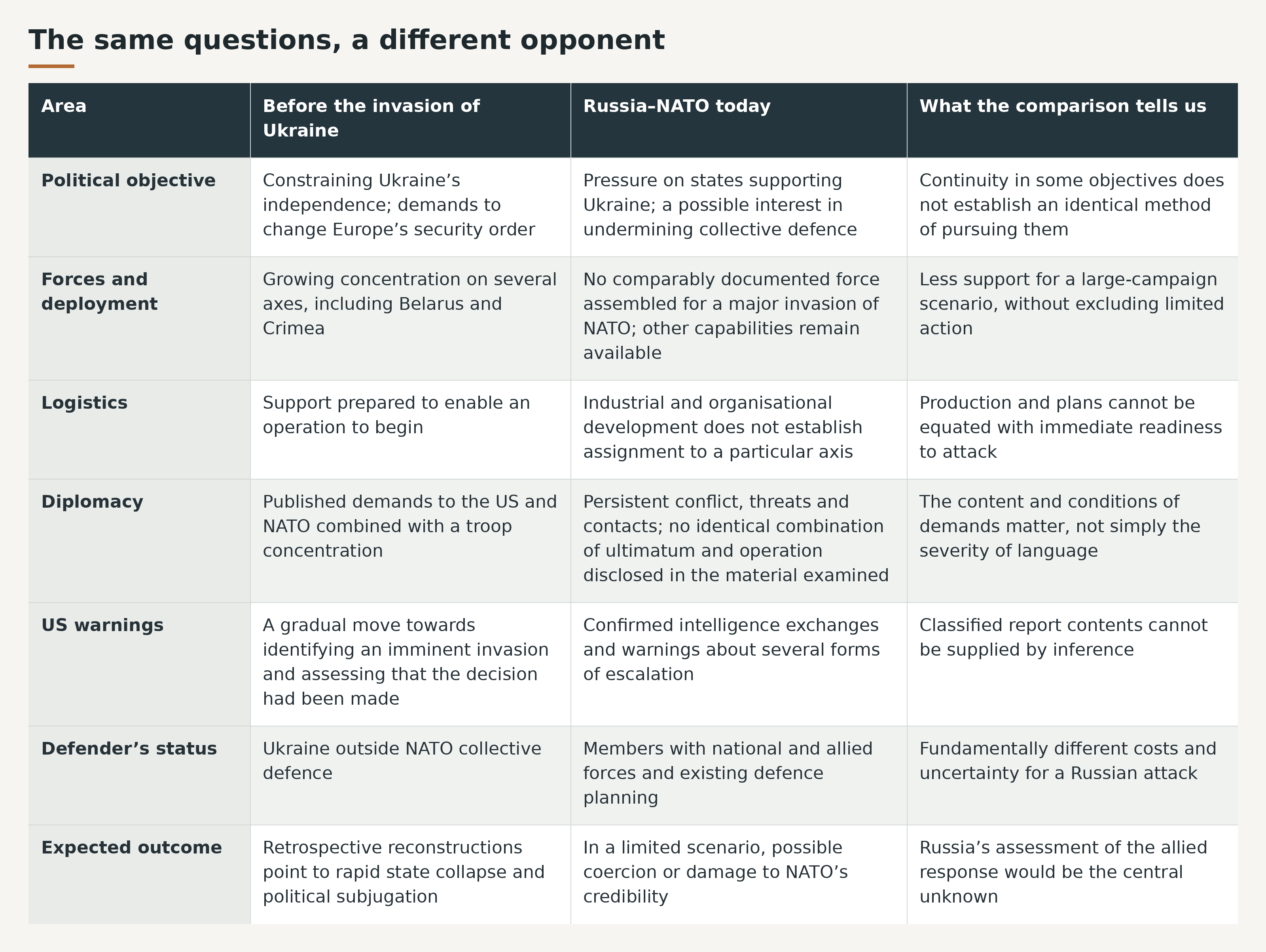
The comparison provides no single historical date to which today’s situation can be assigned. Some processes resemble prolonged capacity-building and pressure; others are immediate incidents. Calling them collectively “another February 2022” would blur the distinction between an operational scenario and an atmosphere of danger. Conversely, treating the absence of a large force concentration as a sufficient guarantee of peace would overlook operations requiring no such preparation.
The most dangerous error would be to assume that Russia must first acquire the ability to defeat all of NATO before choosing to use force against one member. A limited operation could rest on the belief that the Alliance would not use the strength it has. The central question would then concern Russia’s assessment of political willingness, response time and tolerance of risk, rather than the sum of Western resources.
The reasoning cannot be reversed to say that because a limited attack is possible, it is imminent. Technical capability, conditions judged favourable by the aggressor, operational preparation and political decision are separate findings. Some may remain classified, requiring caution. That does not authorise filling every gap with the most dangerous assumption.
When comparison is no longer enough
Ultimately, new preparations determine how a threat changes, even if they do not look exactly like the previous war. If units needed for an operation appear on a particular axis, alongside the support to employ them, concealment or protective measures and a political justification for confrontation, what matters is their fit with a possible objective. Their resemblance to an image from February 2022 is secondary.
A major campaign requires extensive preparation. A limited strike or provocation may leave fewer visible traces. In either case, the relationship between what Russia wants, what it has prepared and what it actually does is crucial. Another threatening statement tells us less than a change in the ability to carry out the threat, although combining the two may reveal the significance of each.
Changes in the character of incidents would also matter. Repeated brief incursions may confirm sustained pressure. Using weapons, causing damage, continuing despite a defensive response or attempting to deprive a state of lasting control over its territory would change the situation. This would be more than a longer list of incidents: it would alter what Russian actions do and where they might lead.
Risk can also increase after a justified defensive response. If both sides raise readiness and change operating rules after an incident, their forces will next encounter each other under different conditions. More armed units will operate in closer proximity, some decisions will be made faster, and commanders will interpret events through the preceding crisis. This is the X → X+1 mechanism: an earlier action changes the available options and the meaning of the next one, without making continued escalation inevitable.

It also works in reverse. A credible explanation, the cessation of particular activities, verifiable withdrawal of capabilities and effective communication can reduce risk. Some soldiers returning home is insufficient if equipment remains to allow the force to be rapidly reconstituted, as the spring of 2021 demonstrated. A lack of media coverage is likewise no proof of de-escalation. Either the conditions that previously increased the threat must change, or new findings must undermine the earlier assessment.
In assessing official warnings, increasing specificity and consistency with protective measures would matter. If different allies, using independently assessed information, began identifying a similar operation, direction and short timeframe, that would carry more weight than many comments repeating one report. It would be equally important to determine whether disagreements reflected different knowledge or simply one country discussing a major invasion while another discussed a limited strike.
The material presented here does not support a responsible conclusion that war between Russia and NATO is inevitable, or that we are in a direct equivalent of the final weeks before 24 February 2022. There are grounds to take limited force seriously, together with the risk of a crisis widening afterwards. Russia’s revisionist objectives, available instruments of pressure and capacity to misjudge the West justify defensive preparation. The threatened countries’ NATO membership, the Alliance’s response and constraints on Russian forces are real factors in the Kremlin’s calculation.
The answer to how close war may be must therefore remain conditional, but it can still be specific. For a major campaign against NATO, the sources examined do not show preparations comparable to early 2022. A limited operation requires fewer resources and may allow less warning. The central questions are whether Russia is moving from maintaining those capabilities to preparing their operational use, and whether it believes the opponent’s response can be contained. New evidence in those two areas could fundamentally change the assessment.
Read next
Related analyses
Escalation, Step by Step: How X+1 Can Become a War Nobody Planned
Why individually rational, limited responses can collectively cross the threshold into direct conflict.
Current assessment
LiveCasualties or serious violations of NATO territory
Assessment time